
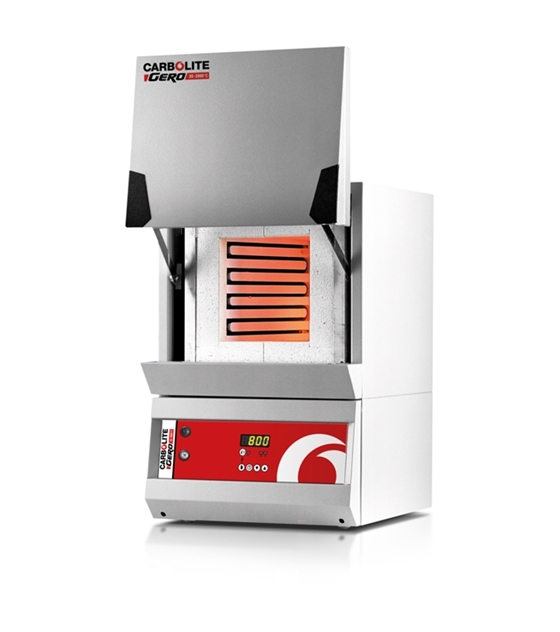
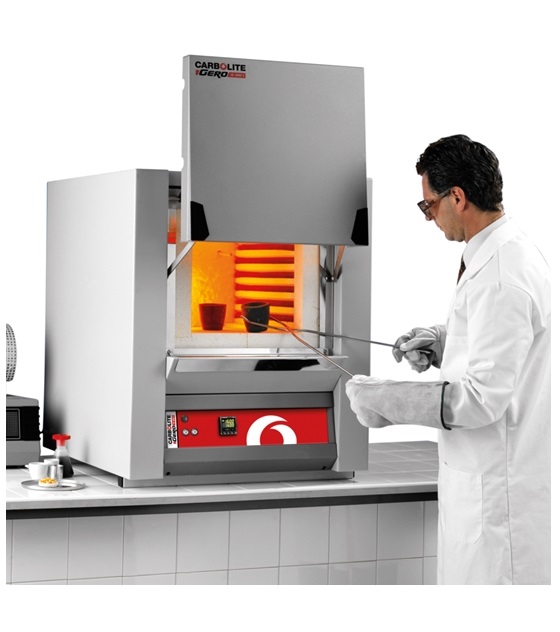
Carbolite CWF Laboratory Chamber Furnaces
The Carbolite CWF Laboratory Chamber Furnaces range is bench mounted and models are available in five sizes with a maximum operating temperature up to 1300 °C.
Key Features
- 1100°C, 1200°C or 1300°C maximum operating temperature
- 5, 13, 23, 36 or 65 litre chamber volumes
- Carbolite Gero 301 controller, with single ramp to set-point & process timer
 Please note - Product designs and specifications are subject to change without notice. The user is responsible for determining the suitability of this product.
 The airflow in the CWF-B furnaces is enhanced by the addition of air inlet holes in the door and a tall chimney which rapidly removes the fumes from the furnace.
The CWF-BAL furnace with integral balance can be used for thermogravimetric analysis (TGA) and loss on ignition (LOI) applications, where weight change of the sample must be monitored during the heating process. This is required, for example, in the determination of inorganic matter content in materials such as cement, lime, calcinated bauxite and refractories. For applications involving organic matter content, please refer to the AAF-BAL.
Standard features
- • Over-temperature protection (recommenSoft closing door on 5, 13, 21 & 23 litre models
- • Parallel action door keeps heated surface away from the user
- • Delayed start / process timer function as standard
- • Hard wearing alumina element carrier, furnace entrance and hearth
- • Energy efficient low thermal mass insulation
- • Free radiating wire wound elements for optimum uniformity
- • Easy access to elements & controls simplifies maintenance & servicing
- • CWF-B: Enhanced airflow from tall chimney & door vents for full combustion
- • CWF-BAL: With integrated balance that runs independently of the furnace control system
- • CWF-BAL: Software supplied with the balance may be used to monitor the balance reading via a computer
- • CWF-BAL: Maximum capacity of balance is 3 kg with a resolution of 0.01 g (other capacities available)ded to protect valuable contents & for unattended operation)
Options (specify these at time of order)
- • Over-temperature protection (recommended to protect valuable contents & for unattended operation)
- • A range of sophisticated digital controllers, multi-segment programmers and data loggers is available. These can be fitted with RS232, RS485 or Ethernet communications
- • A range of metallic retorts to work with modified atmospheres up to 1150°C
- • AMS2750E Nadcap compatible models are available for aerospace applications
- • CWF-BAL: 8 kg balance with a resolution of 0.1 g
- To order contact us via:
Phone: Call +44 (0)330 088 0560 - Email: [email protected]
- Web Form: Get a quote
| Models |
|
|---|
About
© Copyright Cadmus Distribution Group Limited trading as: Keison Products, VoIPon Solutions & 4Gon.


Customer Service
Why us
Payments
We accept the following currencies: GBP (Pound Sterling), EUR (Euros) and USD (United States Dollars).