
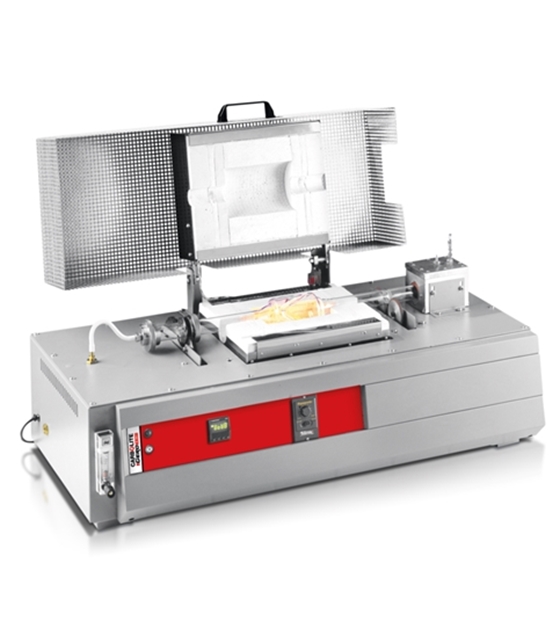
Carbolite HTR Rotary Reactor Tube Furnaces
The Carbolite HTR Rotary Reactor Tube Furnaces combine in a laboratory scale unit many of the advantages of a fluidised bed reactor with those of a rotary kiln.
Key Features
- 1100°C maximum operating temperature
- Developed in partnership with the Imperial College of Science & Technology, London
- Carbolite Gero 301 controller, with single ramp to set-point & process timer
 Please note - Product designs and specifications are subject to change without notice. The user is responsible for determining the suitability of this product.
 The sample is simultaneously heated and mixed under a controlled atmosphere. This overcomes the longer reaction times required in standard chamber or tube furnaces.
Standard features
- • Heating is provided by long life, rapid heating, resistance wire elements mounted in rigid, half cylindrical vacuum formed insulation modules
- • Quartz reaction vessel included as standard
- • The fluted internal surface of the reactor ensures good mixing as the variable speed electric drive system oscillates the reactor tube through 315 °
- • A positive break safety interlock switch cuts power to the elements when the heating chamber is open
- • Gas enters the reactor through a flexible silicon rubber tube
- • A 30 mm flow meter calibrated for nitrogen is provided
- • A single seal gasket directs the reactor exhaust into a removable stainless steel exhaust box from where a gas outlet allows piping to an extraction system
Options (specify these at time of order)
- • Over-temperature protection (recommended to protect valuable contents & for unattended operation)
- • Single or multiple flow meters calibrated for different gases
- • Hydrogen detectors & gas safety system
- • A range of sophisticated digital controllers, multi-segment programmers and data loggers is available. These can be fitted with RS232, RS485 or Ethernet communications
- • Optional inconel reactor
- To order contact us via:
Phone: Call +44 (0)330 088 0560 - Email: [email protected]
- Web Form: Get a quote
| Models |
|
|---|
About
© Copyright Cadmus Distribution Group Limited trading as: Keison Products, VoIPon Solutions & 4Gon.


Customer Service
Why us
Payments
We accept the following currencies: GBP (Pound Sterling), EUR (Euros) and USD (United States Dollars).