| Home › Lightning & Surges Protection › Electronic Systems Protection |
|

|
  |
|

|
|
For coaxial Ethernet cables running external to the building use the ESP Thin/ThickNetESP Net-100. Local protection for PCs and computer communications with D type connectors running within a building use the ESP LA/LB series. models. For Cat 3, 4 or 5 cabling with RJ45 connections running external to the buildin use the Application Use on network cables running within a building to protect systems locally from transients induced onto data cables from the magnetic field caused by a lightning strike. Features and benefits
|
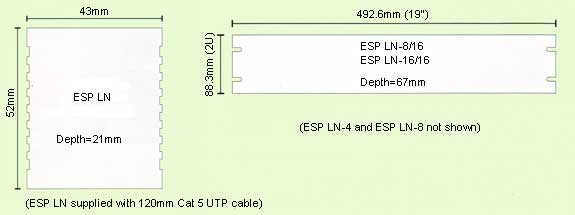
* Note: ESP LN-4 and ESP LN-8 are not shown. Installation Plug in connection between incoming data cables and equipment to be be protected. Make suitable attachment to earth. Technical Note ESP LN... range of protectors are designed only for use on cables running within a building, and therefore will not be able to handle the higher level transients that occur when lines between buildings are protected. They should not be used in such an application. If they are used in lines between buildings, there is a high risk of the protector being overloaded and destroyed during transient activity. Connected equipment will, in most cases, still be protected, but there is a small risk that equipment will suffer damage in such circumstances. |
||||
 Use on
lines running within buildings
Use on
lines running within buildings Let-through voltage
below equipment susceptibility levels.
Let-through voltage
below equipment susceptibility levels.
| Electrical Specification |
| |
ESP LN | ESP LN-4 | ESP LN-8 | ESP LN-8/16 | ESP LN-16/16 |
| Maximum working voltage (note 1) |
4V | 4V | 4V | 4V | 4V |
| Current rating | 300mA | 300mA | 300mA | 300mA | 300mA |
| In-line resistance (ohms) | approx zero | approx zero | approx zero | approx zero | approx zero |
| Data rate (TIA Cat 5) | 100Mbps | 100Mbps | 100Mbps | 100Mbps | 100Mbps |
| 1 Maximum working voltage (DC or AC peak) measured at 1mA leakage. |
| Transient Specification |
| |
ESP LN | ESP LN-4 | ESP LN-8 | ESP LN-8/16 | ESP LN-16/16 |
| Let-through voltage (note 1) 1.5kV, 10/700µs test to: BS 6651:1999 Appendix C, Cat C-Low ITU (formely CCITT) IX K17 |
12.5V | 12.5V | 12.5V | 12.5V | 12.5V |
| Maximum surge current (note 2) | 350A | 350A | 350A | 350A | 350A |
| 1 The maximum transient voltage let-through the protector
throughout the test (+/-10%) line to line and line to earth. Response
time <10ns. 2 Tested with 8/20µs waveshape to ITU (formely CCITT), BS 6651:1999 Appendix C. |
| Mechanical Specification |
| |
ESP LN | ESP LN-4 | ESP LN-8 | ESP LN-8/16 | ESP LN-16/16 |
| Temperature range | -25°C to +70°C | -25°C to +70°C | -25°C to +70°C | -25°C to +70°C | -25°C to +70°C |
| Connection type | RJ45 sockets | RJ45 sockets | RJ45 sockets | RJ45 sockets | RJ45 sockets |
| Earth connection | External earth strap | TBA | TBA | External earth strap through mounting screws | External earth strap through mounting screws |
| Weight unit packaged |
0.05kg 0.09kg |
0.029kg 0.58kg |
0.32kg 0.61kg |
0.75kg 1.1kg |
1kg 1.35kg |
| Dimensions |
|||||