
Home > Valves & Flowmeters > Micronics Portaflow 300

Micronics Portaflow 300
|
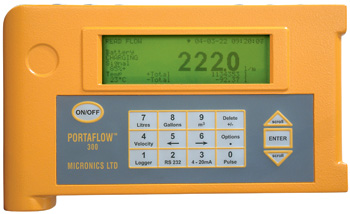
The Portaflow 300 brings a new simplicity to the
non-invasive measurement of liquid flow. This clamp-on
ultrasonic instrument offers the user quick and accurate flow
measurement from outside the pipe. PRINCIPLE
The Portaflow 300 is a Transit Time ultrasonic flow meter that
has been designed to work with clamp-on transducers, thus
enabling liquid flowing within a closed pipe to be measured
accurately, without the need for any mechanical parts to be
inserted through the pipe wall or to protrude into the flow
system. When ultrasound is transmitted between transducers
X and Y, the speed at which the sound travels through the
liquid is accelerated slightly by the velocity of the liquid
through the pipe. |
ELECTRONICS
The Portaflow 300 electronics are housed in an IP66
enclosure which incorporates the graphic display, keypad,
sensor and output facility connections. The Microprocessor
driven electronics makes the instrument respond quickly to
any instructions given. Programming the unit is carried out by
selecting the options displayed in the main menu and by
following the simple instructions given. Flow readings can
then be achieved on most applications within a few minutes. TRANSDUCERS
The Portaflow 300 is able to work with four different
transducer sets, depending on the application. High
temperature sensors are now supplied as standard. The
instrument is supplied with transducer sets 'A' and 'B' as
standard. Transducer sets 'C' and 'D' are available as options
to increase the velocity and pipe range of the instrument. 'D'
transducers will only work up to +80°C and are supplied and
are supplied seperately with webbing straps. Chains are used
to secure the guide rails to the pipe. Magnetic assemblies are
available for the 'B' guide rail only.
|

Data Sheet
Please note - Product designs and specifications are subject to change without notice. The user is responsible for determining the suitability of this product.
Portaflow 440IP Portaflow 330 Portaflow 220 Stingray PFD550 Permanent Ultraflo 1000 Ultraflo 3000/4000 Ultraflo D5000 UF AV5000 Heat Meters CALEC ST CF ECHO II |
Want A Quotation? |
About
© Copyright Cadmus Distribution Group Limited trading as: Keison Products, VoIPon Solutions & 4Gon.


Customer Service
Why us
Payments
We accept the following currencies: GBP (Pound Sterling), EUR (Euros) and USD (United States Dollars).